

The loss of HMAS Sydney (II) is Australia’s greatest naval tragedy. Its disappearance in 1941 without a trace left a legacy of uncertainty for decades. In March 2008, renewed efforts to find the Sydney came to fruition, confirming her fate and bringing closure to the mystery.
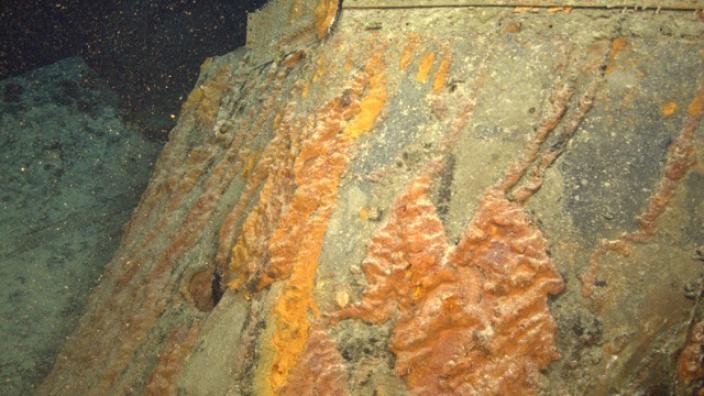
In 2015, a further expedition to survey the historic World War II shipwrecks produced new photographic evidence which appears to confirm why Sydney was so quickly disabled, leading to catastrophic damage and the devastating loss of everyone on board.
Celebrated for her successful battles in the Mediterranean, where she famously sank the Italian cruiser Bartolomeo Colleoni, HMAS Sydney (II) and her crew of predominantly young men received a hero’s welcome on her return to Australia in February 1941. She was then tasked with escorting troopships to South East Asia, following an Indian Ocean route along the west coast of Western Australia.
It was on the return of one of these voyages that she encountered the German Raider HSK Kormoran, on 19 November 1941. The Kormoran was disguised as a Dutch merchant vessel that was seemingly incompetent at returning the Sydney’s signals, unaware, the Sydney approached the unknown vessel. Once within range where her superior armament could not advantageously defend her, the Komoran used the advantage of surprise and brought all its armament to bear on the Sydney.

While neither ship survived, the Sydney was lost with all hands – a complement of 645 young men. 318 of the Kormoran’s complement of 390 survived.
For 66 years, controversy raged. The Kormoran survivors were the only witnesses, and were generally dismissed as unreliable. Endeavouring to not discourage the Australian public during war time, the media was censored and families received standardised bereavement letters. In the subsequent decades, many people postulated theories, remarkable finds were discovered then found to be hoaxes, and the depth of the sea at suspected wreck sites kept researchers from investigating further.
A renewed effort to find the Sydney and Kormoran, supported by modern technology, came to fruition on 16 March 2008, when a small group of Australian volunteers, the Finding Sydney Foundation, discovered the Sydney shortly after locating the Kormoran wreck, around 100 nautical miles off the coast of Western Australia.

Soon after the ships were found, an inquiry was launched into the Sydney’s disappearance. The Commissioner the Honourable TRH Cole, AO, RFD, QC, found that it was an error of judgement that brought the Sydney to a distance where she was overpowered and sank. The enquiry helps bring closure to the families who never knew for sure how their loved ones had died.

Experience History in 3D: ‘Fire on the Water’
Venue: Rose de Freycinet Gallery | Shark Bay World Heritage Discovery & Visitor Centre
Screening Times: Every half hour, on the half hour
Admission: Free | Permanent Exhibit
Step into a pivotal moment in Australian naval history with our immersive 3D film, ‘Fire on the Water’ film. This powerful cinematic experience tells the dramatic story of the WWII battle between HMAS Sydney II and the German raider HSK Kormoran, one of Australia’s most enduring maritime mysteries. This moment in time is considered Australia’s greatest Naval disaster.
Screened every 30 minutes in the dedicated Rose de Freycinet Gallery, this free, permanent exhibition allows visitors of all ages to engage with this important historical event in a visually compelling and educational format.
Whether you’re a history enthusiast, a student, or a curious traveller, ‘Fire on the Water’ offers a moving insight into a significant chapter of our nation’s past. Don’t miss this opportunity to explore the legacy of HMAS Sydney II through state-of-the-art 3D storytelling.
Visit us at the Shark Bay World Heritage Discovery & Visitor Centre and experience history like never before.
Exclusive to the Shark Bay World Heritage Discovery & Visitor Centre: The exhibit is permanent, free and screens every half hour during opening hours.
Astonishing deep-sea 3D imagery reveals the fate of the Australian warship HMAS Sydney (II) and the German raider Kormoran, tracing the events of their World War II battle off Shark Bay.

In 1941, on the Indian Ocean off the West Australian coast, an encounter between a Royal Australian Navy cruiser and a disguised German raider led to the worst naval disaster in Australia’s history.
HMAS Sydney (II) and all 645 officers and men were lost. Across the nation, there was shock, grief and disbelief that Australia’s most celebrated warship had vanished.
German survivors from HSK Kormoran, who had abandoned and blown up their own damaged ship, made it to shore. They gave their accounts of the battle and told of seeing the Sydney destroyed and ablaze, drifting away into the night.
Almost 67 years passed before the wrecks were finally found in 2008, west of Shark Bay at the great depth of 2,500 metres. In 2015, an expedition to the wreck sites used remotely-operated vehicles to gain extraordinary imagery of the two ships on the seabed.
Here, 21st century technology offers compelling illumination of this dark moment in World War II history. From the time the two ships sighted each other on the horizon through to the tragic aftermath of that encounter, Fire on the Water traces hot the battle unfolded on that fateful evening off Shark Bay.
In collaboration with the West Australian Museum, ‘Fire on the Water’ is part two of a historical maritime trail which begins with ‘From Great Depths’ at the Museum of Geraldton, commemorating this significant Australian Naval disaster.
In 1941, on the Indian Ocean off the West Australian coast, an encounter between a Royal Australian Navy cruiser and a disguised German raider led to the worst naval disaster in Australia’s history.
HMAS Sydney (II) and all 645 officers and men were lost. Across the nation, there was shock, grief and disbelief that Australia’s most celebrated warship had vanished.
German survivors from HSK Kormoran, who had abandoned and blown up their own damaged ship, made it to shore. They gave their accounts of the battle and told of seeing the Sydney destroyed and ablaze, drifting away into the night.
Almost 67 years passed before the wrecks were finally found in 2008, west of Shark Bay at the great depth of 2,500 metres. In 2015, an expedition to the wreck sites used remotely-operated vehicles to gain extraordinary imagery of the two ships on the seabed.
Here, 21st century technology offers compelling illumination of this dark moment in World War II history. From the time the two ships sighted each other on the horizon through to the tragic aftermath of that encounter, Fire on the Water traces hot the battle unfolded on that fateful evening off Shark Bay.
In collaboration with the West Australian Museum, ‘Fire on the Water’ is part two of a historical maritime trail which begins with ‘From Great Depths’ at the Museum of Geraldton, commemorating this significant Australian Naval disaster.
For more information on HMAS Sydney (II) please visit the Western Australian Museum’s website.
Funded by the Australian Government with additional support from the Shire of Shark Bay and the Western Australian Museum.
Images credits: Curtin University and the Western Australian Museum.
